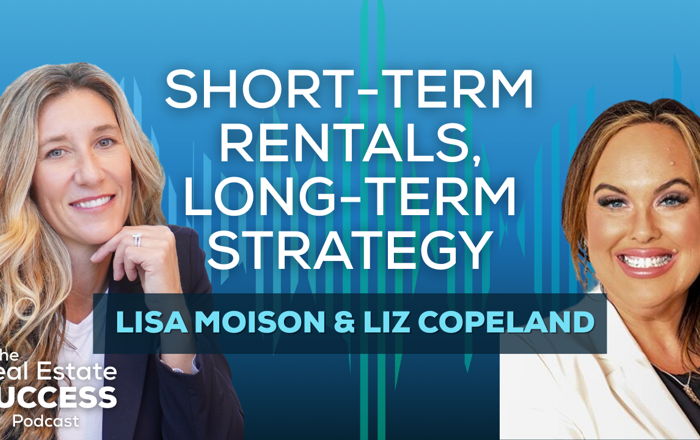
Short-Term Rentals, Long-Term Strategy: Finding Your Niche in a Crowded Market with Lisa Moison and Liz Copeland
December 11, 2025
My guests on today’s podcast are two powerhouse professionals—Lisa Moison, a seasoned real estate agent with over 25 years of experience in short term rentals across Montana, Colorado, and now Virginia Beach, and Liz Copeland, a sharp and strategic lender at Cross Country Mortgage with a background in wealth management and non-QM lending.
Welcome back to The Real Estate Success Podcast. Today, we’re diving deep into a niche that’s booming—but more complex than it looks: short-term rentals. My guests on today’s podcast are two powerhouse professionals—Lisa Moison, a seasoned real estate agent with over 25 years of experience in short term rentals across Montana, Colorado, and now Virginia Beach, and Liz Copeland, a sharp and strategic lender at Cross Country Mortgage with a background in wealth management and non-QM lending.
Together, these two have built a dynamic partnership focused on helping buyers and investors navigate the ever-changing short-term rental landscape, from zoning regulations and overlay districts to financing strategies like DSCR loans that prioritize the property’s income over your personal financials.
Lisa shares what it took to build a short-term rental business from the ground up, sometimes quite literally, with one baby strapped to her front and one on her back; while Liz gives us a behind-the-scenes look at the lending process and why having the right team changes everything.
We also talk about the power of niching down in your business, the value of collaboration over competition, and how defining success as daily joy or helping one person each day can lead to a more fulfilling career.
This episode is packed with insight, especially for agents, investors, or anyone considering getting into the short-term rental market. So let’s jump in.
Guests: Liz Copeland and Lisa Moison
lizcopelandteam.com
Take the FREE Financial Health Assessment here: realestatesuccesspod.com
Episode Transcript:
Leland Gross
Welcome back to the Real Estate Success podcast. Today, we're diving into a niche that's booming, but more complex than it looks, short-term rentals. My guests on today's podcast are two powerhouse professionals, Lisa Moison a seasoned real estate agent with over 25 years of experience in short-term rentals across Montana, Colorado, and now Virginia Beach, as well as Liz Copeland, a sharp and strategic lender at Cross Country Mortgage with a background in wealth management and non-QM lending.
Together, these two have built a dynamic partnership focused on helping buyers and investors navigate the ever-changing short-term rental landscape, from zoning regulations and overlay districts to financing strategies like DSCR loans that prioritize the property's income over your personal financials. In this episode, Lisa shares what it took to build a short-term rental business from the ground up, sometimes quite literally, with one baby strapped to her front and one on her back.
while Liz gives us a behind the scenes look at the lending process and why having the right team changes everything. We also talk about the power of niching down in your business, the value of collaboration over competition, and how defining success as a daily joy or helping one person each day can lead to a more fulfilling career. This episode is packed with insight, especially for agents, investors, or anyone considering getting into the short-term rental market.
So with that introduction, I hope you enjoy this episode of the Real Estate Success podcast with Lisa Moison and Liz Copeland.
Leland Gross
All right, welcome Liz and Lisa to the Real Estate Success Podcast. I'm excited to have you guys here today. Thank you for having us. Of course. I would love to start this conversation with a little bit of a background on who each of you are, kind of what you do, so the listeners have kind of a foundational perspective. So each of you give us a little bit of your story. All right, I'll go first. I've been in real estate for about 25 years.
I started out in Montana when I was 20 and came across a wonderful woman who had taken me in, trained me up, got my license then. It was a resort market then. I ended up moving from Montana to Colorado, ended up in another resort market, and now I'm in Virginia Beach. So I ended up being in those different resort markets, really learning about investments and short-term markets and things like that.
I've also owned a short-term rental company in Colorado for about 17 years. And essentially that came about, had buyers who would come in, say, I'd love to buy a piece of property, but now what do I do? And I'm not much of a no person, so I said, I'll figure it out, let's do this. And spent my time learning everything it really took to manage a short-term rental in Colorado.
two babies that, you know, I put one on the front, one on the back. I started snow shoveling and learning how to do hot tubs and cleaning properties and then learning how to manage and over time built up a quite a bit, a good business there. We had about 50 properties at one time for quite a while. And then while also selling real estate. So having moved to Virginia Beach, I still have that company in Colorado.
And it's a very well-oiled machine there, but I also just learned so much about the short-term rental market and how valuable it can be for buyers and people to be able to own properties and still offset their cost of ownership. That's awesome. What about you? I'm Liz Copeland. I'm a sales manager at Cross Country Mortgage. I've been in mortgage for about 15 years.
I got into mortgage basically, you know, a friend of mine thought I would be good in the business. I have done everything from, you know, back in the day was a makeup artist and I got into the wealth management sphere because again, somebody else recommended me for that. Loved that. I learned lending within wealth management. So I did lending for a client book in wealth management and then actually decided that I wanted to
be able to work with everyone, not just who was on our client book, and got into, you know, originating mortgages. We started in Charlottesville, Virginia, got to Virginia Beach about four years ago. I've always been in the new construction realm, so when I started in mortgage, I...
quickly got wrapped up in new construction. So that's always been half of my business. And then the other half of my business has been working with agents like Lisa on resales. And then in Virginia Beach, once I started with Cross Country Mortgage a couple of years ago, I realized that we have such an array of non-HUEM products that I started diving into them to see what we could actually do at Cross Country that wasn't available to me at other companies before.
And one of those things was a loan specifically targeted, DSCR loan specifically targeted for short-term rentals. So having met Lisa through a group of badass ladies, she and I talked before and I knew that she was looking at really focusing and building a niche on that short-term rental market. So it just seemed like a good fit.
with me having this amazing product at Cross Country to be able to help Lisa build her business with short-term rentals and work on that together. And Lisa, remind me, when did you transition from Colorado to Virginia Beach? I've been here about two and a half years. I work for Atlantic Sotheby's and I've just kind of got into the Sandbridge and the Virginia Beach market, really started to learn about the short-term rental market in Sandbridge, but then also Virginia Beach because it's such a
very specific area. have an overlay district, which you're not allowed to short-term rent anywhere and everywhere in Virginia Beach. So really learning that target market of where can you rent? What are the projected revenue opportunities there? So I've been here about two and a half years and learning the market here. Yeah. I'm sure there is some level of complexity because of the Virginia Beach restrictions, which haven't been forever.
I mean, short-term rentals haven't really been a thing forever. But for those who don't know or who might not be in the Virginia Beach area specifically, in our city, because we have such a history of tourism, when Airbnb and VRBO were really taking off, they put in some restrictions on you can't just rent out any house anywhere. It would cause too much competition with the hotels and things like that. And so there's really strict nuance on
where your house is located, even things you were sharing about like parking, how many parking spots you have with your house compared to the amount of bedrooms and having certain plans for that, which makes it really difficult to be able to produce that in Virginia Beach. Now we have Sandbridge, which is a separate area and that's free to be short-term rental pretty easily. But I would say speak to that because I think as, whether you're another agent,
or a real estate investor, short term rentals are a great way to build wealth, great way to build income, and you almost have, if you're getting into it, you have this rose colored glasses of like, this house is near a beach, I could easily Airbnb this, boom. And then you get into it you're like, wait, there's so much more to that than most people initially think. So share a little bit about what the overlay district is, how that works, and kind of how you, when you've worked with
Short-term rental owners or investors kind of how you help guide them in that, okay? So yeah, I Will talk just fairly specifically about the Virginia Beach Overlay district because that one is is very different than anywhere else But coming from Breckenridge Colorado We had we had been doing short-term rentals so much longer. I think that this feels very new still in Virginia Beach for some reason
so so I've watched the market shift and watched things change in Breckenridge, but really learning that market and what it really takes, right?
short-term rentals have really been looked at very specifically as far as, like you said, competition with hotels in the area, but also quality of life for owners that are, that live in the area, having, you know, maybe being next to a property. But, you know, I've had a lot of owners, or lot of buyers that I've worked with that have come in, very, like you say, they came in, they said, hey, I'd love to buy a piece of property here at the ocean or the mountains.
What's that going to look like? And for us, it's really easy to say, well, okay, let's take a look. And it is a little bit of rose colored glasses. Hey, you my brother-in-law is a realtor and he said I can buy a piece of property and I can short-term rent it. But there's just so much more that goes into this particular type of market. And so working very specifically, and this is kind of a niche that I've really dove into and spent a lot of time with a lot of buyers in.
And there's just a lot of work that goes into it. And then also, preparing all this and finding properties that one can be short-term rented. What's the quality of the house? What's the bedroom size? I there's so much that goes into qualifying a property and then being able to hand it off to a lender. And a lot of times I'll go to my lender and say, okay, now I've qualified three properties, I've identified these to my buyers.
Now let's take it to the lender and find out because remember with the DSCR loan, you're not qualifying your buyer, you're qualifying the property. So there's just so much work that goes into the backside of buying one that a lot of people aren't prepared for. They just think, well, if I can find a piece of property that I really like, I'll just short-term rent it. In the overlay district, very specifically in Virginia Beach, you could be on a half alley and one property can be short-term rented and one cannot. So also really understanding
the location of each individual property. The short-term rental market or the city of Virginia Beach has gotten really strict on their requirements for the short-term rental district. Parking has something to do with it, I believe right now it's a parking per bedroom. You have to have a parking spot per bedroom. And if you don't, you have to have a plan for that. So you have to be able to say, okay, I don't have a parking spot per bedroom, but I've got a parking garage half block away.
and then they will be able to put that into perspective for you and also use that. Decks are a huge thing right now in the short-term rental for the city of Virginia Beach. We've had some situations where people weren't keeping their decks up, you had a big party and the deck has fallen off. So they're really strict right now on that and that will also be a big part of your qualifying for a short-term rental. So there's all these things that go into it. We go into even an offer and we have to now say,
Will the property qualify? Can we get a loan? Does the property actually meet the needs and the standards and the expectation to actually get an occupancy permit for that? So there's a lot of things that go into it, but that's essentially kind of where we start is, you know, letting the buyer, you know, helping the buyer understand. And also, of course, revenue. Revenue is like the biggest thing. I have to go in and...
Put it up against a certain program that I have a software that we use to determine what the short-term rental potential will be We get into then the appraisers and the appraisers come out and and it's not now not just a normal appraisal because the appraiser actually has to be has to understand the The revenue aspect of it and appraising the revenue. So Although it's I mean, there's just there's a lot of working parts, but if you have the right people, know We are doing a lot of it on the backside
The buyer doesn't need to come prepared with that information. We have that and we just walk them through it step by step and it's worked out really well. So my understanding of what you're saying is, we come and we have, whether it's a software, whether it's packages of like, hey, here is the home that we have already identified because we know this is something you're interested in. So we've identified these three properties. We've...
research the overlay district we believe these ones qualify and we've already run the report on here is projected revenue expenses you need to be ready for as far as you know cleaning fees and you know other fees associated with this and then so basically this one already qualifies do you need to pull permits like does the city need to get a have you already like run to come to the city and pulled like this is now permitted for rentals is that a thing or is that something they have to do once they purchase the home
Yeah, great question. So if the property is already being short-term rented, then it already has its occupancy. It's a cup. It's a permit that you already have through the city of Virginia Beach. So if you already have that in place, it will transfer with the property, not the owner, which is great to know because in some areas, those permits for short-term rentals actually transfer with an owner, not the property. But here in Virginia Beach,
they do transfer with the property. However, some of these properties are in the actual location of the short-term rental district, that overlay map, but they're not being short-term rented. And the sellers haven't gone ahead and gotten that permit in place either. And you're looking at about three to four months right now to actually get a permit, like get your application in and then have the city approve it.
And so that's definitely something you have to work with. Again, if the property is already has a short-term rental and has its permit, which we'll see a lot of that more in Sandbridge. I still go to the city of Virginia Beach. have these amazing people that work in the city of Virginia Beach that I'm able to call up and say, can you look at this property? Are there any violations on it? Is it in fact in the short-term rental overlay district?
Here's the parking situation and they'll help me at least they'll guide me a little bit like yeah This would be something that you know, we don't foresee having any issues with permitting on But you know again some of these properties are not currently permitted so we do our best to kind of gather up all the information And then provide that to the buyer but also to the city of Virginia Beach. So they kind of know it's coming down the line, right?
And so we have to be prepared for that. But yes, we do break down all the costs for our owners. I mean, we have a really good idea and obviously it's an average, but we have a really good idea of what each individual thing is going to cost when short term renting. We also have really good short term rental companies that we, know, either we kind of refer out and have them help us as well when guiding the buyer.
into that situation just out of the gates, you what is this going to look like? But then also potentially being able to take over the property for them once they've purchased. Some homeowners don't want to be totally hands on. They would rather have a company that they trust to take over the short term rental and be able to meet those needs of the short term rental. Totally. I think that's so valuable. And I want to jump into the DSCR loan product here in a second as well. But I'm curious, is that something you would also help with sellers? Like I'm thinking if
You have someone who's selling on the oceanfront who might have a house that's not permitted but is in that overlay district. Is that something you would encourage them to do? Like, it'd be a good idea to just get permitted for this before you sell because that opens you up to a whole new set of buyers who might be looking for a rental opportunity. Or is that... Or am I crazy?
No, I don't think you're crazy at all. In fact, I think there's a lot of missed opportunity, specifically in the short-term rental overlay district in Virginia Beach. I think that a lot of people, again, it seems fairly new. You have a lot of agents that, you know, this is new to them. It's not necessarily something that they work with. So it's a missed opportunity. Often enough, I will say to listing agents, man, I really think it could be valuable to get in there, have your, because it transfers with the property.
Have your seller go and get that part done because wow what a value for a buyer to go yes I can see it's in the short-term rental district. This is what my revenue is gonna be We've put the revenue up against the purchase price And I get to step into the income because the hardest part really is Saying to a buyer. Yes. I think we can now you have a small percentage that this might not happen Even though all you know all the signs point to yes we always have to write on the fact that what if
Also, you have three to four months of sitting, buying a property and sitting off the market for the rentals for three to four months. So now you have to go to your lender and say, well, I have to have reserves. I mean, your lender is gonna say, do you have three to four months of reserves to stand out because you're not gonna necessarily, well, you're gonna be sitting on this property and you're not gonna be able to rent it, right? And there are ways around that. would say, then you can do the longer term rental, put somebody in there, a traveling nurse or somebody like that to.
be able to add some income to your property while you go through that process. But it's also you're not stepping into it going, know for a fact that I have this short term rental permit. So I definitely think with sellers, I think it's a missed opportunity. I think there's a lot of value added, especially in a world where not, you know, we're talking about affordability, right? Affordability is such a big conversation right now in our current market. And what a great way to be able to say, I can actually afford this. I can build up.
my real estate portfolio, offset my costs. That would be, you the worst case scenario is you're gonna offset your costs and in some situations, you actually can pay for, you you'll be able to actually pay for owning that piece of property. I'm working with a buyer right now where we're doing that exact same thing right now in the Virginia Beach Overlay District. I've identified the property and now it's just putting all those pieces together for him.
to be able to see if that will in fact work. Because not every number works with every property. Yeah. Right. Well, that's what makes having an expertise in this or a niche in this so valuable is you're like, there's so many pieces at play beyond just a primary residence, purchase or sale. Where it's like, do you qualify? What house do you want? Great. There's so many more regulations and rules and numbers. And will this be profitable? Will this not be profitable?
All of that comes into this very differently. And on the conversation of affordability, I really want to hear from Liz just, you know, in this situation. So Lisa's got a buyer, she's found someone. There's a real value to being qualified on the property itself and not on yourself, like your own finances, especially when you do have a real estate portfolio that might be pushing up debt to income ratios and things like that if you were to qualify personally. So.
Speak to that and kind of when that transition happens when now you're entering the picture on the getting qualified spot in the transaction. Absolutely. So that's a great question. Lisa and I worked together from the beginning. So once there is a property identified, we start looking at the property rather than at the buyer. And that's the benefit of
the DSCR loan is that we're qualifying the property. So Lisa and I have the same software system where we can run a report to see what that projected income is going to look like for that property. Because with this type of loan, you're not looking at DTI for the borrower, right? You're not looking at their income. You're not getting their tax returns. You're really qualifying the property on is the rental income.
projected rental income going to support this transaction. Now there are things that come into play for the borrower, right? So we do run credit. They do need to have at least six months reserves on most transactions. You know, it's a little, depending on, know, where we, depending on the property and the ratios for the projected income, you know, that can be a little dependent on that. But typically it's about six months reserves, right?
We're going to look at the bar's credit. We're not going to count any properties against them. So with Fannie Mae, if you're doing a regular investment loan, you know, Fannie Mae only wants you to have 10 finance properties. So, you know, this person could have 20 finance properties. We're not looking at that because we're qualifying the property. But in addition to bank statements showing reserves, one thing we ask is that if there are
mortgages that are coming up on their credit report that we just see mortgage statements to verify that the payments are up to date on those mortgages, but it's again not to Disqualify them on debt to income ratio, right? So those are two amazing things for buyers is that hey, I gotta get my credit pulled I gotta show some reserves. I might have to show some mortgage statements, but I'm not having to show WT's I'm not having to show tax returns. I'm not having to show
fully executed lease agreements for the other five properties I own, things that would normally happen on a regular Fannie Mae investment, 20 % down loan. Especially I can imagine, obviously this is not an accurate rule of thumb, but many real estate investors have some level of self-employment which makes tax returns really hard. When what you make and what is reflected as your tax bottom line income,
isn't totally like the exact accurate what resources you have to be able to pay that. That's one of the biggest challenges. Like buying homes, always hear when we work with our clients, it's always the, like I need to reflect more on my tax return to qualify for this amount of money. And the sheer amount of like W-2s and things like that that you need to provide can become really difficult. But saying, hey, here's my bank account, there's plenty in here. I'm coming ready to put money down and ready to do this.
but it's being qualified on the income of the property, not the income of the individual. I think that is huge. And like you said, especially when people get really into this and they're building real estate portfolios, which are wonderful wealth building tools, know, certain places like Fannie Mae, there's caps on how many you can have. having a look at, we're just looking at this property. If this property can cash flow, you're good. And if you have the reserves, obviously, because...
I think what people don't think about is that lenders, they're really just risk assessors. It's like how secure are we gonna be that when we give you this money, we're gonna make this money back? And which makes sense why they're saying, will the property make enough income? And should there be some situation where the property doesn't get rented or there's a vacancy issue? Do you have reserves to make that? And are your past mortgages or your other previous mortgages up to date? Great, that tells us.
you are a reliable person and this property is cash flowing. Now we can do this without having to look at your personal income and liabilities and things like that. I think that's 10 out of 10 valuable. Absolutely. And another benefit is that at Cross Country, we can actually close in an LLC, right, for these loans.
So it's really important to note that, that in a lot of situations, if you are closing on an investment property, you're having to close in your name and transfer into an LLC after the fact with Fannie Freddie.
in this situation, we can actually close in an LLC, which is super appealing to most investors. And the other thing that Lisa and I have talked about a lot, which I think is really important too, is that we actually underwrite these in-house. So we have a non-QM department right in-house at CCM where we underwrite these. We have the ability to broker them out if we need to.
But obviously it is so much more beneficial for me to be able to work at in-house with our non-QM team. I can get the underwriter right there on Microsoft Teams and go over everything. I know Lisa and I were looking at one recently and I was getting really fast responses when we had some questions from my non-QM team because we're literally ping, Lisa and I are on the phone going over numbers and I'm pinging my non-QM team asking questions and literally it was very fast that I was getting responses back. So I think
That is super valuable because we know that as we go through these transactions, and like Lisa said, there's a lot of work on the front ends that we do before they're even under contract. We can get the answers we need very quickly and be able to move forward with the transaction and have, I would say, a smoother transaction than sometimes you have when you have to broker things out and you're waiting for responses back. Yeah, I totally agree.
It brings up this idea of niching, which we've talked a little bit about, that I think is really valuable. And what you're speaking to is, I think a lot of people think, you know, every real estate agent is the same. Every lender is offering the same stuff. Every financial planner does the same stuff. And in these worlds of, in the service industry, it's like you just can't serve everyone. And we're...
in a world that's growing so quickly, there are just new needs and developments that to work with a team that understands the area, one, which is a duh, but also like the short-term rental world, like, hey, this is exactly what we're doing. And to work with a lender who has a specialty in non-QM loans, it's gonna be a totally different experience because you guys can come, hey, we've pre-prepared a lot of this.
We're proactive, not reactive. And we know this. We're experts in this market. Hey, we've got a team that can write this in-house. We've got underwriters, which underwriting is the biggest nightmare of the transaction as a whole. It's like, that's the most like, what's going to happen here? You know? And so the more you can have that under control, really adds so much value. But I think this idea of becoming a specialist or niching is
a relatively like 2000s idea. I mean, in medicine, we've been doing that forever because you got to, it's like, you're just a heart surgeon. When our son had open heart surgery, was like, we've got a lady who only does this exact surgery on hearts that are smaller than the size of a quarter. And you're like, well, I'm really grateful you exist. I don't want anybody else doing this. But in other service fields, we've kind of been in the like, if you can fog a mirror.
I will work with you. Right. And it can feel scary, I find, to niche and say, hey, you know, I really specialize in this and you're looking for that over there. You almost have this fear of, well, I lose out on business by really becoming hyper focused in what I do. But I really think that or my experience in my own field is that's almost the opposite when they do studies. It's like those who have a specialty, then everybody goes to you for that specialty.
then you're hyper efficient because you're like, know this, it's wash, rinse, repeat. I know this. I've got the muscle and systems built. I'm not doing a short term rental one day and then, you know, a jumbo loan the next day and then a first time home buyer the next day, you know, which maybe you are. But when you have your kind of niche focus, I think it really drives a lot of value. So I guess speak to that from your experience in real estate of, you know, building a specialty market and
how that's either gone really well or how that's been hard or just kind of what your thoughts are on that. Because when you're self-employed or when it's up to you, it can feel really easy to just go after the low, like I'll just go after anybody. Especially in the early days, I find when you're like, I just need to income. Right, right. 100%. Yeah, 100%. I mean, I tell all my agents, I've had this conversation with you before, you know, and I tell my builder partners, hey, look, if a lender is telling you,
that they do everything well, that is not the case. I mean, that is absolutely not the case. So you've gotta be able to, I think, to say, hey, this is what I do well, and this is what I don't do well. And I say this all the time, anybody watching this who knows me knows, if you come to me, and I had an agent the other week come to me, their client needed grants and VHDA and all this stuff, and I sent them to my friend Marty because she is great with VHDA.
I, you don't want me doing a VHDA loan. You don't want me doing a grants because that has never been my niche, you know? So I'm gonna send those to a lender friend of mine who I know does them really well. Amy Carr, Marty Guy Fink, they're great with grants, they're great with VHDA. If you need that, that's where I'm sending you. I would be a hazard to you and your client, you know? But for short-term rental, for non-QM, for...
jumbo, I do a lot in the jumbo space. You know, I am your girl and I've really specialized in those products and I think that coming from the background in wealth management, it kind of naturally put me there. I do a lot in the new construction space as Lisa knows. Half my book of business is builder, so I do that. And you know, I do help clients that...
do regular conventional loans. I have a ton of those. I do a lot of VA in this area. I've done VA for a very long time. And FHA, I do a lot of FHA. But that's kind of my wheelhouse right there. And if you start coming at me with we need VHDA, I...
I'm not your person and I'm okay telling you that because I want people to have the best experience. Buying a home, people have to understand. mean, it's the largest financial transaction in our clients' lives. Like buying an investment property, same thing. It's a huge financial transaction. You want people who really specialize in that to be the ones taking care of you. And so I think once you get to a place in your business where you understand that, then that really opens a lot of doors.
Yeah, I totally agree. What would you say? You know, I agree also. I don't specialize in everything. Very specifically, I'm a second homeowner, investment, short-term rental agent. Over 25 years, that is really the market that I know. And so I don't go out there trying to market an appeal to every single person. I think that I best serve my clients in this particular market. And yes, of course, I have very similar.
somebody wants to come and just buy a normal condo and live in it, I'm not going, well, I can't do that. But I think that we have capabilities of that. again, right, military relocation and certain things aren't necessarily where I'm at. And you wouldn't see any of my marketing trying to force myself on anybody for that. But I do think that this is very specifically something that, it is hard, it's a lot of work. And I think that that's something to know.
I think a lot of agents would say, oh, I can do that. I mean, I can figure out a short-term market or a short-term rental house for you. And certainly they could, but it is a lot of work. You're going to, you I do a lot of back, a lot of back work, you know, as far as identifying properties. When things are hitting the market, I'm immediately, as soon as it hits the market, I'm already looking it up, checking out the mapping, calling up the city of Virginia Beach, maybe calling her, you know.
A lot of times, very similarly, we had a property that just listed and I was so excited about it. It's in the short-term rental area in Virginia Beach. It's two blocks from the dome, right? I just start to see, wow, this has got some real value to it. I call her up and I say, okay, here's the list price. Here's what the revenue, this is what my projected revenue is on it.
You know, we've also have to look at interest rates and all these other things, right? So she started breaking that down. We even have to call the insurance, I call it my insurance guy, and I have him give me quotes. And so we're really trying to bring it down to be really accurate, as accurate as possible. And interesting that we had to actually go backwards to find out, the property is overpriced if you're going to use it as a short-term rental. So then we had to go, OK, now what would the buyer actually have to offer in order to make that work?
Now we haven't tied up a buyer, we haven't tied up their earnest money, we haven't wasted their time taking something off the market, we haven't wasted the seller's time, because ultimately we were able to draft that all up and be able to put that in place and go, okay, so this is what somebody would have to get this for in order for it to work as a short-term rental. Regardless, even though it feels like, it's in the market, it's in the short-term rental market, seems like a great price, the location is great, but we still couldn't get the numbers to totally work.
So I would say that as much as I think anybody can do anything, how well are you gonna serve your client? Well yeah, and I think that is so valuable to come and say, hey, there's a property. Like you said, you haven't gotten committed to this at all. But now we can help you really craft an offer that makes sense for you. Whether the seller sells for that, that's up to them. But we can say confidently,
If you buy it at this price, it's not gonna work. But if you buy it at this price, it will. And now we can craft a compelling offer and go from there. Like that is the real value there. And I think what you said, Liz, of being able to confidently say what you don't do. Like I feel like we all are wrestling with the imposter syndrome and wanna be the expert in all things and be all things to all people. But being able to say like, A, I know just enough to be a hazard.
And this also just doesn't bring me life. Like we have to realize like we are in this not just to make a living ourselves but to enjoy our lives. Like that's why I love working with self-employed professionals, variable income professionals, people in kind of the heart of their career. Lots of financial planners would say like I love working with retirees and Social Security and Medicaid and I'm like wonderful. That makes me want to poke my eyes out. So and I think it comes from this place.
I think when you can feel confident saying like, is my expertise, there's so much more of an abundance mindset there to say, there is now enough. Like, I don't need to go work with anybody who can fog a mirror, who needs VHDA or military relocation. I don't need to do that because there's enough to go around for all of us. maybe I'm referring out, like, I love that you're like, this person has this niche, so I'm gonna actually send this person over there.
I'll forego the commission on that to give it to them because they're going to get served better. And there's such an abundance mindset there that says like, there will be enough. I will be OK. You know, and we found like our some of our best referrals come from other financial planners at this point who are saying like, hey, you just know this space. So here you go. And we send our referrals all the time when it's like, you we use the medical analogy of like you are
really in need of a heart surgeon and we're an orthopedic surgeon. So like same world, but we're gonna get you to the right person for that. And A, it just makes our life so much easier. Like I look at my calendar and I'm like, I like all these people. The work I'm doing is really impactful and the work that I really love and do really well. And you know, our business begins to flourish because then other people can say, hey, you know, this is the short-term rental team. Like you have a short-term rental, boom.
they're gonna out serve, they've got the expertise, they know how to do this. But it's really interesting that I do feel like that is becoming so much more of a thought process in many professions, where it's like, how do you become a specialist? And are you okay? Do you have the abundance mindset to say, yes, you can forego a transaction in order to really do the work you love and the work where you provide the biggest impact? Yeah, I totally agree.
Yeah, I very similarly, I feel like I've had other agents on the other side of these transactions, you know, if they've got the listing and I might be bringing the buyer and I go, okay, so now here's all the things we have to do to get this to closing, you know, and they're like, whoa, wait, what's happening? And I'm like, it's so exciting, you know, I'm really excited. I can't wait to run the numbers and get on the phone with her and see what's happening.
And a lot of other agents are like, that is a lot of work just to try to get that deal done. I'm like, yes, but can you imagine what's going to happen next? Totally. And that's how you know you're in the right. I feel the same way. are like, you like looking at self-employed professionals tax returns? You could just work with a retiree. It's pretty simple. I'm like, yeah, but that's boring. Look at this. This is so fun. I mean, that's.
That's the beauty of it. And we're not all created equally. Like we're given different gifts and different passions. And I feel like the more we can work our way in there, it's just a win-win all around. Like our businesses flourish better. We're then just flourishing more because we're doing what we love. And then the consumer gets the best service possible. But I do think it's hard, right? Like when you first get into a profession, like if there's any new agents listening to this, it's like,
That's a really hard, you may a, not know what your specialty is yet because sometimes it just takes reps to be like, that was really fun. That was a nightmare, you know? And you want to get to yourself to a point where like you can afford your life and then start specializing. But I would, I personally would encourage and I'd be curious because you guys are boots on the ground in the real estate world. I would encourage at least any financial planner, like find a niche, find a specialty.
really begin crafting your marketing that way, because then you draw more people that want what you do and what you like to do, and just battle the imposter syndrome that if I only do this, I'm gonna end up eaten by a tiger under a bridge, homeless, everyone's gonna leave me because I'm gonna be unsuccessful because I'm only gonna work with these types of people. It's like, just not how that works. I think the biggest turning point for me in my career,
was realizing that, was realizing, okay, these are my specialties. Ooh, these are definitely not. You know, this is the market that I thrive in. This is the market I'm good in. And then also realizing, and I think that this is so important to understand. When I look in the mirror, that's my competition. My competition is not other lenders. I'm friends with lots of other lenders. know, Cynthia Lewis is one of my best friends. You know what I mean? I adore her.
And so like being able to, I had somebody say the other day, well, do you mind if other lenders come to your event? No, have them come. I want them to come. Let's hang out. Let's be friends. What do you do well? Like, let me tell you what I do well. And so I really think, like you said, operating with that abundant mindset and just knowing, hey, I know what I'm good at. I know what you're great at. I know what you're great at. Let's go grab a drink or have a coffee or whatever is so important that we, you know, we...
we form camaraderie in our industry instead of competition. We collaborate with each other. And I think that was the huge turning point in my career when I realized, wait, this is all about collaboration. I'm not competing with all these people. This is what I do well. This is what they do well. Let's collaborate. Let's send clients back and forth. Let's really work together because we're here to serve. And we're only gonna serve well if we can work well together in an industry that is
you know, of course it's a very competitive industry, but we've got to work well within that competitive industry and really collaborate for the benefit of our clients. yeah, I agree. Yeah, I've I've heard before like industries sell, professions serve. I have like, you think of, again, I just think medicine's an easy one. You've got like the medical device industry or medical sales, like pharmaceutical industry, they're selling stuff, but then you have
the profession of medicine, like the doctors, the people who are serving. And it's interesting, I feel like there is a turning point from a consumer perspective where they want more of a service than a sale. And so it's like, even if we're selling a product or we're selling a home, it's like, how do I change this into a profession? And I think part of that is, like what you're saying, of it is competitive, but how do we break down that wall?
How do we become more colleagues who serve and realize even if we do the same thing really well, we can grow from each other. We can learn from each other. If you get this great client, that doesn't mean I'm not gonna get a great client. That doesn't mean, that means I can cheer for you and say this is great and learn from you or offer guidance. I just feel like that is so much of a
better way to go about business and a way that isn't always how it's treated. I've had other advisors be like, I can't tell you where I get my clients because you might poach them. I'm like, brother, you're not going to have a monopoly and neither am I. And I'm sorry you feel that way. I'm just trying to get coffee. Yeah, I know. It's so true. I I've had other lenders and other, you know.
doing events and they don't want any other lenders at their events, and I'm like, why not? Why don't you welcome the collaboration? Welcome, I'm not coming to your event to talk to your clients or to steal your agents or anything like that. We can all collaborate. So I mean, I think it's important and I think that, like you said, when people get on that same page, that is what makes things really tick.
Just, you like you were talking about the cardiologist, for instance. Could you imagine, you know, if your PCP didn't want to refer you to anyone and thought that they could do that by themselves? I mean, that's insane. so you have Lisa over here specializing in the short-term rentals and, you know, saying, hey, I'm not great with VA relocation. So.
You know what Lisa's niche is and you know that sending a client to Lisa looking for a short-term rental is beneficial to your client. That's the way to best serve your client. Not send, you know, maybe sending a VA Reload somewhere else, you know, is a better idea and sending Lisa her niche and having done this for so long in Colorado.
having come up and had your own short-term rentals. mean, you know the business like you said, with a baby strapped to the front and strapped to the back and cleaning up. survived. Yeah, exactly. I mean, you know, really like boots on the ground, like rolled up your sleeves and you know the industry inside and out. I would love as we wrap, this is a podcast about success. And I have found, you know, if you ask anybody like, hey, how do you define success? You're gonna get a different answer from each person.
I would love to know for each of you, kind of in your stories and your journeys, both throughout your whole career, but also in the light of the conversation we're having, how do you define success and how will you know if or when you've achieved it?
You wanna go or you want me You go first. Okay. You know, I've been asked this question a couple times and I think at the point in my career that I'm at now, and I've felt this way for the last couple years, but I look at HOPE, H-O-P-E, and it's help one person every day. So for me, if I can help one person every day, at least one person, then I feel like I've been successful that day.
So that's really how I define success is really being able to help and serve others and do it well. So for me, it's like a daily look at that. You know, so every day when I get up and I do my meditation, that's one thing that I really focus on is, you know, hope, help one person every day. I like that. And I'm supposed to follow that? mean, it's now it's now a competition.
Listen, I did forget to tell everybody I really am very competitive. But she collaborates well with me on these short-term rental numbers. You know, I feel like over my journey in life, success has been more finding joy every day. think that joy is something that doesn't come easy. And so I think helping people, but also just doing what I do, do it well. Do it with heart and with integrity. And I think that that's
you know, the world is such a hard place. Then you get put in a world where you are competing, you you're in sales, you know, kind of feeling. And really deciding a long time ago when I was really young, having really great mentors that were like, never sell like you're hungry, right? Like never, don't live like you're hungry kind of thing. And really being able to hone that in when I was still a sponge and was still really young in the business. And then waking up every day going, okay, I'm not gonna, I...
I feel like I'm successful because I got to get in front of these people, but also got to learn something about them. I got to be a part of an experience and got to do it with my kids. And still, in all of that, got to have joy. Joy is kind of my level of success, I feel like. I love that. And you're a joyous person. Since I've known you, I would say you're a very joyous person. I like both of your definitions. Obviously, we hear a lot of them on here.
Again, I really think it's a personal conviction, but I like that both of yours are kind of an as you go success, not a end zone you're trying to achieve. Because what I find is oftentimes when we say, when I get here, that is a belief. I actually read something the other day that it's like the monastic fantasy. If I only had more time or if I was only at this other place.
then I would be more connected. I'd feel more alive or successful. And it's like that breeds mostly just scarcity and frustration in a belief that like life begins there or like life is achieved there, not in my current realm, in my current circumstances. And so I like that both of yours are in my current day to day, which may be a total mess. Like the day could be a total nightmare, but if I carry it with joy,
or I help one person, great, I'm successful. There's like this beautiful contentment in that of like, okay, what am I pursuing each day? And it's in each day. Like, the mercies are new every day, every morning. We're just waking up and pursuing it, you know? And it's not this grand, once I have a certain amount of money or a amount of respect or my life looks a certain way, then I will be there. Which, unfortunately, how often are people living their life like for the future?
and not just finding what is success today. I really love that. I feel like I did have that at some point in my life though. When you've been there and you kind of do the, when I own a house, I, you you put yourself, because I found myself being a workaholic at times in my life and just totally honing in on my level of success and especially in real estate and it being such a competitive world, but also, you know, everything just.
feels like it dictates who you are, your level. And having little kids in that time frame where I was, I was putting them in the car. I my son, I was 24, I had my son, and I was so, I lived in this world in my mind that was so determined to be successful on monetary and the number of sales, that I had my son and three days later, I had him in my office. I was sitting there, right, and I'm looking at everybody else like,
see what I can do, you should be able to, you know, and I kind of did that, was 24, I was young, you know, but it didn't take long for me to then, as my kids got older, kind of have that mom guilt of like, oh man, I spent so much time, I mean, they were with me, I didn't put it, you know, they towed it around and showed property, it was a time, it was a different time, you wouldn't do it now, and it was like in a small community in Montana, where people would allow you to bring your baby to work. I would not suggest doing it now, but.
But then I got that mom guilt later on and went, you know what, I'm actually gonna seek joy over what monetary success or my level of sales or, know, because then I think it's hard to, it is hard, it's actually hard to be joyful with other people around you or you feel like you have to, you know, like you said, of keep your, everything close to you, you don't want to share it. know, all that kind of comes with trying to keep up with the world and the people around you. So I choose joy now.
Totally. When you don't wanna, you I think the fear is like, is what I'm pursuing, am I gonna get to the top of the ladder and realize the ladder's on the wrong wall? Like am I gonna pursue, you know, this definition of success and then when I'm there, when I've achieved it, I'm like, wait, this actually isn't fulfilling. wait, I've missed out on my kids lives, you know? And it's like, that's what's, you know.
honestly very real and I do believe definitions of success change over time. Like I think there's freedom for that to be the case too. We're all growing and evolving. Like, you know, I'm sure in 20 years I'll look back and be like, I wish I parented differently than I am right now because in 20 years, Lord willing, I will be wiser. But my kids are getting the best they're gonna get right now. And so I believe there's room for growth and change, but I do think that there is this place of like, I want to be pursuing
a life, a definition of success. I want to be pursuing something that is lasting and not climbing a ladder that's on the wall that's actually on fire. The analogy that I like, there's two I use with my kids. Well, I have two grown kids and one teenager, but these analogies I use with them, the one is it's the football field analogy. I'm a boy mom, so I use the football field analogy where we.
you're always, if you do that, you're always moving the goalpost further out, right? So you think, like when we're younger, because I was like you, and that way you think when you're younger, okay, when I hit this, then I will feel successful. But then the goalpost just moves. Do you know what I mean? Like it just moves further. So you never really reach the goalpost, because as soon as you reach it, you want more, it moves further. So that's why I like to look at it in a different way now, you know, now that I'm...
I'm older in my career, older and wiser, right, in my career. And the other one I always like to tell my kids too is I think of Mario. You know, you guys played Mario back in the day, right? yeah, came on. You know how Mario was like, he was always having to jump over that alligator to get to the next level, right? And if you think of your life as levels and you have to keep trying to jump over that alligator, and the more you jump, the more you try, the more you learn, the more you grow,
It's like your journey, right? And you don't get to the next level in your journey until the alligator hasn't grabbed you and pulled you down into the water, right? So your journey through life is a lot like Mario, and you see yourself going through these times where the struggle is real, you keep getting pulled down by the alligator, right? But those are the times that you're.
and growing the most. And once you kind of learn through and grow through that time, instead of fighting through it, you grow through it, then you see yourself, okay, you're at the next level. And then, you know what I mean? So if you think of life and your journey as growth, not struggle, you know, that's, I feel like that is a really great way to set yourself up for success, is enjoy the growth. Don't worry about the struggle. I totally agree. Well,
Lisa, Liz, thank you guys so much for coming on, sharing your story, sharing your wisdom and expertise with us. I kind of want to have you guys back on at another time just because I feel like we could, in this sphere, have five conversations about this. But thank you for being on here today. Thank you for having us. Yes, thank you. we do have a lot to say, so please have us again. We're chatty.