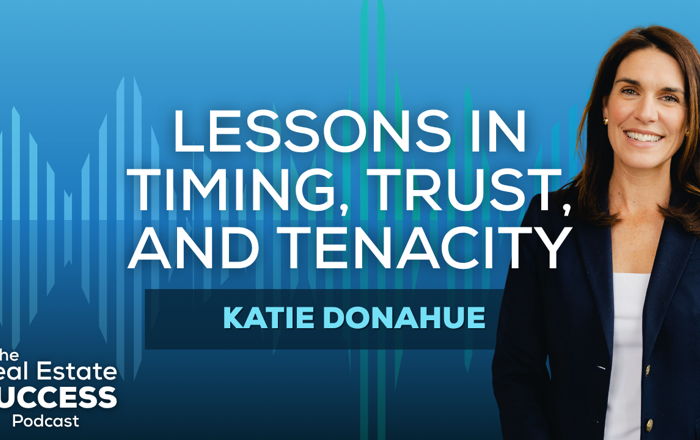
Lessons in Timing, Trust, and Tenacity: Katie Donahue’s Success Story
May 7, 2026
My guest on today’s podcast is Katie Donahue—a top producer in the Hampton Roads area and the recent recipient of a 2025 Top 3% Producer Award.
My guest on today’s podcast is Katie Donahue—a top producer in the Hampton Roads area and the recent recipient of a 2025 Top 3% Producer Award.
Katie’s journey into real estate is anything but traditional. After a successful early career in nonprofit leadership and years as a stay-at-home mom navigating active duty military life with her husband, Katie found her way into real estate not through a master plan, but through curiosity, creativity, and courage. From turning her first home into a rental property to attending real estate classes at night with her dad while raising three kids, Katie’s story is rooted in grit and a lifelong love of learning.
In this episode, we dive into the reality of building a business while raising a family, how she leveraged every opportunity—including a unique part-time marketing role within her real estat team—to enter real estate on her terms, and why deep care for people is at the heart of her success. Katie talks about the value of mentorship, the humility of lifelong learning, and how rejection and market downturns taught her to trust the timing and focus on the fundamentals.
Whether you're a new agent juggling family life or a seasoned pro looking to redefine what success means, Katie’s story is full of wisdom, grit, and the kind of honesty that’s rare and refreshing.
Connect with Katie:
Instagram: @kmodonahue
Transcript:
Welcome back to the Real Estate Success podcast. I'm Leland Gross, certified financial planner and the founder of Peacelink Financial Planning, where we specialize in helping realtors manage their finances and grow their businesses. My guest on today's podcast is Katie Donahue, a top producer in the Hampton Roads area and the recent recipient of a 2025 Top 3 % Producer Award. Katie's journey into real estate is anything but traditional.
After a successful early career in nonprofit leadership and years as a stay-at-home mom navigating active duty military life with her husband, Katie found her way into real estate not through a master plan, but through curiosity, creativity, and courage. From turning her first home into a rental property to attending real estate classes at night with her dad while raising three kids, Katie's story is rooted in grit and a lifelong love of learning.
In this episode, we dive into the reality of building a business while raising a family, how she leveraged every opportunity, including a unique part-time marketing role within her real estate team, to enter real estate on her terms, and why deep care for people is at the heart of her success. talks about the value of mentorship, the humility of lifelong learning, and how rejection and market downturns taught her to trust the timing and focus on the fundamentals.
So whether you're a new agent juggling family life or a seasoned pro looking to redefine what success means, Katie's story is full of wisdom, grit, and the kind of honesty that's rare and refreshing. And so with that introduction, I hope you enjoyed this episode of the Real Estate Success Podcast with Katie Donahue.
Leland Gross (02:15)
All right, welcome, Katie, to the Real Estate Success podcast. Thank you. I'm so excited to be here. I'm excited to have you on, especially I know you just won a big award for top producer in the area. So that's awesome. Yes, yes. It was a great year. 2025 was a great success story, which is awesome. I love it. Well, start by telling our listeners a little about who is Katie Donahue. OK, so I could go on for a while about this, but.
I, well I'm a believer and I am originally from New England. So go Patriots, very excited, Pats are so back. And I am a wife. I've been married to Eric for almost 17 years. We've been together for 23, so feels like a long time. A good but long time. And we are parents, so we have three, I wanna say young kids, but we're really not young anymore.
They're growing so fast. So we have a 13 year old, a 10 year old and an almost eight year old. She would want me to say almost eight because it's just a couple of weeks away. I am honestly shocked to hear that because when I picture your kids, I think of them as like 10, seven, four or whatever that age gap would be. I can't believe the oldest is official teenager. Yeah, it happens. I mean, everybody tells you it happens fast and you're like, yeah, yeah, yeah, whatever. But the reality is it really it flies by. I still feel like a young mom, but I think that gap is rapidly ending. You're a young.
Teenage mom. Yeah, that's right. And every new season, you're young to that season. That's right. That's right. I'm not sure my daughter would say I'm a young mom, but you know, it's like that line gets drawn somewhere. Yeah. Sometimes I look at my kids and I'm like, when I was your age, my parents seemed so old and I'm just out here doing my best. I feel like a spring chicken. Well, actually I feel exhausted, but in my head age-wise. Yes.
I totally understand that. think that it's so tempting to be like, we're so young, we're so young. But then you hear some of the things, you see some of the things, and you're like, yeah, we're not that young. Yeah, Millennials are out. Well, tell the listeners, how did you get started in real estate? Tell us a little bit about your journey there. Yes, so it was multiple years, honestly. We started out, so Eric was, let's see, OK.
He did 20 years in the military and so that's a big part of our story just in general. And so he was active duty military for 20 years. I say we really because it feels like active duty is a family. Yeah, it's a family sport. Yeah, family affair for sure. 20 years in the military, but 16 of those we were married and I was originally a nonprofit work. And so I got my master's in public administration doing the nonprofit thing. And actually, when I went into nonprofit work, my dad was like, you know,
you do know that you need to make money. And I was like, I'm in my 20s. Who needs money? that was, that was, and he was right. It was a wonderful time in my life. And I got to work for two awesome local organizations. But the reality is, is that when we, could do that when we had our first child, but we went to have our second child, the daycare costs were just so expensive. And the nonprofit that I was working for at the time just couldn't pay me what I needed to make in order to make that worth it. So I moved to being a stay at home mom.
And I was that for five years and we had a little surprise third baby in there. And we just need additional monthly stream of income, basically streams of income. And so we started with we had made our first home a rental property when we bought our current home. And then we bought a second rental property and we would just try to get the mortgages really low so we could make good streams of income on a monthly basis from the renters.
And that was sort of our first voyeur into real estate. I also was like a serial zillowest, if you can call it that. It's like where I love to be. And so that was sort of the start. And I was at home and if I'm being really honest, I wanted to embrace that time, those five years. And I'm so thankful that I had it. But I think if I'm being really transparent, I missed working and I missed being.
with adults and having that time as well. And so I wouldn't give that time up, but I did feel this urge to return to the workforce. And a couple of things had changed in those five years. One was my parents moved here, which was huge because Eric was traveling approximately 50 % of the year. So I really needed help in order to go back to work. And then also my dad, who had been in commercial real estate as a lawyer for his whole career, but he was in New York or Connecticut.
had said, do you want to do this real estate school with me? I want to learn the local laws. And is this something you'd be interested in? And one thing about me is I just love to learn. I'm a huge closet nerd. I guess I'm not a closeted nerd anymore. being open about it. But You're very much putting it on a podcast. Yeah, that's right. I'm just an open nerd, open nerd. And so he said, would you want to just come learn about real estate? You guys invest, and you like being landlords, and you think you want to keep doing that. And it just could be interesting for you.
The reality about real estate school is you don't learn as much about real estate as just how to pass the test. But being a nerd, I still found that quite interesting. And also, one of the best parts about being a stay-at-home mom and going to a night school was at 5 o'clock. Didn't matter who was melting down. I was able to be like, mom's got to go to school. That is awesome. You're like, well, good luck, Eric. I got to go to school.
You know, they're all melting down into the worst two hours of the day. Yeah, exactly. It was five o'clock at night. was literally the witching hour. And it was like, sorry, mom's got to leave. anyway, just did that. I was just really open to, would that lead to anything? I didn't know. The hilarious part is I was sort of praying about going into being a marriage counselor. And I can now confidently say, if you do real estate, you also do a decent amount of marriage counseling as part of your job. So.
I started talking to different teams. felt like joining a team would be just a good way to enter real estate. But my biggest hang up, I would say, is I still had a two-year-old at home. I really didn't feel ready. And I think this is something I've tried to tell other people, obviously within reason. But sometimes I think we're called to do stuff before we really feel ready to enter it. And so I was meeting with these teams.
And just sort of reassuring these team leaders, like, look, I'm going to work so hard for my clients. That's not a question. But the reality is, is I can't have my butt in a chair five days a week. You know, I can't go from zero hours out of the house to 60 hours out of the house. And so some team leaders were more open to that than others. And one really kind of cool story that happened that felt like confirmation was I had been meeting with a mutual friend of ours named Amy, who's a mentor for me.
She mentioned Kaylee Powers to me and I had never met John or Kaylee. That's not true, I had met Kaylee once but I hadn't met John yet. And so I wrote Kaylee's name down on a post-it on my kitchen counter. I thought, okay, it's a Friday, I'll call her next week. I'm not gonna bother her on a weekend but this mutual friend, Amy, said, you they're in real estate and I bet they would love you and you guys would work well together. So anyway, I thought, okay, I'll call Kaylee next week and that next day, Kaylee actually texted me. It was really cool and just said, would you wanna get together? We heard that you're getting your license and.
and we'd love to meet with you. so that was, we went out, I guess that was the spring or early summer of 2020. And just a really cool initial conversation with them. That's awesome. Okay, so you were in real estate, I mean, kind of in real estate from birth, just because of your dad, like kind of growing up with someone who's connected to real estate. So was sort of in your orbit. And then,
taking time to be a stay-at-home mom but missing the workforce and wanting something that can also support motherhood. And then from there, had some rental properties. Did the rental properties come, they came after nonprofit? They came a little bit during nonprofit and then after nonprofit. Okay.
So kind of, hey, we want some extra income, now we're landlords, we're enjoying it, you said, which I feel like is a hot take. Some people are like, I think it just depends on the personality. Some people really love it, and then some people really struggle with it. And then your dad moves to town and says, let's take this class, and that kind of, how did you, I guess my curiosity in that is how did you know, you're like, right, marriage counseling, real estate, I'm taking this class with my dad, when did that?
switch and yeah, guess help me connect to that. Yeah, no, it is. It's sort of a circuitous route. So I think I really enjoyed the class. I already knew I enjoyed real estate and just looking at homes and all that comes with that. But I think you can be a zillowess and still not necessarily want to do real estate. And so I just I think I was just open to let's see where this goes. And so I knew a few teams.
I started broadly talking to people. And the real move away from marriage counseling honestly came from another conversation with a friend who was in the midst of getting her counseling degree. And I'm not going to remember the number, but I want to say that there was like 1,000 clinical hours or something like really intense to get licensed. And she had three young children also and just sort of said.
She was very honest and she was like, my honest advice is don't do it. And she's an excellent. She's a counselor now. She's excellent. I send people to her, but she was sort of like, this is really hard to do with three kids. And if I'm not mistaken, I don't think you get paid for the clinical. Anyway, so it just kind of made sense that that was, I think sometimes we feel like a door is shutting and that's that felt like that was shutting and the real estate felt more attainable. Which, yeah, I think that makes total sense. I remember.
I really wanted to be in international relations. And then as I was getting closer, the sheer amount of unpaid internship hours to get somewhere, the sheer amount of, I just was like, what that would actually look like in my quality of life isn't necessarily what I want. And that sort of led me into another path. So you're talking to team leads, which I think is, I see agents who are kind of like, I'm just gonna
I'm gonna like avoid the split and I'm not gonna go on a team. And my personal opinion, which I think everybody's journey is their own, but I'm like, I think joining a team is incredibly valuable, especially early on to just learn the ropes, have the support it's worth. In my mind, the split until you're kind of at a place where you say, either I like the culture of this and I'm fine with it, or I'm ready to do this on my own. But you sit down with Kaylee what made that different than
the other team leads or kind of, because you ended up, spoiler alert, going with that team. Yes. But yeah, why did you choose the powers or that team? I mean, it was a combination of things, obviously. But one thing on just a really rational level is real estate is hard to get into like any 100 % commission based entrepreneurship. guess maybe entrepreneurship is 100 % commission based.
any kind of job where I had only ever been corporate or nonprofit. So this was my first time basically saying I'm going to invest in a business before I'm ever going to get paid. I had always worked a job where two to three weeks into the work, you're getting a paycheck. And so this was scary because I still had a two year old home. We, at least right now and back then and still to this day have chosen a private Christian education for our kids. So we had
legitimate bills to pay, and I'm telling my husband, I'm gonna get a job, but I don't know when I'm gonna get paid. That's a scary proposition. And so on a really rational level, I was very honest with John and Kaylee, and I'm so thankful for them giving me a try, because I was honest with a lot of people about not necessarily being able to jump into committing 40 hours a week out of the gate. And understandably, there's team leads out there that are like, that just doesn't work for our model.
And truly now I can say there's not really part-time real estate. There's flexible real estate. There's being able to work around some of your family's needs, but there's not part-time. But that's kind of what I was conveying to team leads. And John and Kaylee, who I think also had a similar vision at that time for growing their family, really understood that. And so I felt comfortable saying to them, is there something I can do for your team on an hourly level, in addition to building my real estate business?
where I can just have that safety net that I'm at least gonna get the childcare paid for. Not so much the school tuition, but just the two-year-old. I'm gonna have to find sitters for her. My parents have been an amazing help. Like I said, I couldn't work without them, but they couldn't cover everything either. And so John and Kaylee were generous and said, yeah, what if we paid you hourly to do some marketing, do some things for our team? That gives you a cushion. Because I had actually had another realtor sort of condition me.
it's probably going to be about 12 to 18 months before you're seeing regular paychecks. Like just get that in your mind because it is hard at the outset to invest, invest, input all these hours and just not really know. Like until you get to a closing table, you're not getting paid. anyway, that was on the most basic other than just connecting with them as people really liking who they are and their values and.
things like that, of course, that was huge in making the decision, but on a very, very basic level, they were able to support me in sort of branching out into the field. Yeah, I love that. And I think that it's honestly a really creative solution of, hey, we'll pay hourly for you to do some other work for us. Like, what a gift of a opportunity, as you said, as someone who's like, I need to pay for childcare. I also want to grow my own business here, kind of underneath you. But,
So you're jumping in, now you're like half marketing coordinator and realtor. What was that like in the early days as you're kind of figuring out from like textbook knowledge to real knowledge, like to experiential knowledge? What were those early years like, especially starting in spring of 2020, there's a lot of uncertainty in the world. Now, straights were great. We haven't had the like insane inflation yet, but.
I guess what was that early like okay? I'm officially in this now What was that like for you? Mm-hmm? mean It's it's hard and good well 2020 ended up being an amazing time to start in real estate We of course we have hindsight now at the time everybody was batten down the hatches nobody moved But then when interest rates were good and people actually took stock of where they were living and we're spending more time at home I think it was the catalyst for people to say let's change where we live. Mm-hmm. So I end up being
an amazing time to start in real estate, but at the time it was nerve wracking. And so I was so thankful, yeah, so John and Kaylee, I think I did 16 hours a week for them. And it was a balance between what do need to get done for my clients and what do I need to get done for the team. But again, there was a lot of flexibility around that I think I committed to two days a week in the office and then whatever else I needed to get done for clients and for the team outside of that. And so it grew quickly.
to the point where I was just trying to remember, I think I only did that for John and Kaylee for about, I don't even think it was 18 months. I think a year into doing that, I went back and said, thank you so much for giving me this opportunity, but the clients are enough that I really need to put my focus into them. so that was an amazing launching point. And I agree, I think the synergy of still being in real estate, because you can start in real estate.
and you can do something else hourly. You could go be a barista or do whatever, but it was very cool to have something where, I'm actually working in real estate, learning in real estate, and also building the clientele. So it all felt like it worked together. Yeah. One, hard when I see people who, in any field, I see this in any sort of commission field, when people don't jump full feet into that field and they are doing the barista thing. Like you can do it, but you're just slowing down.
the progress because you have to give so much time to this whole other outside thing. So the fact that you're still in there building relationships, you know, in the office with other agents, like there's probably so much that was there that I think was probably so powerful to, like you said, have that I'm supporting my income while still being in the field or like being in the real estate sphere is really, really powerful.
So you take off quickly. I think it is really sobering to hear 12 to 18 months. really cool that at 12 months you're like, all right, well, we're ready to do this thing. Fly. Yeah. And then from there, I feel as though your success has sort of done like a hockey stick graph, which has been really sweet to see. The questions I have on that are, what caused that? Or what are your keys to success? feel like some people are like, I really
found a niche service or I really launched into social media, I guess for you, what were some of the keys to success along the way? And then I know since then, you've gone out on your own. So how was that kind of decision? So those are two totally different questions. I want you to answer them at the exact same time. I can do two podcasts on those topics alone. So OK, key is a success.
I was trying think about this. think one of them is, as I said, ⁓ I'm now completely out of the closet, open nerd. And so I do love learning. And one thing that is important to me more than marketing, I would say, is really knowing things. It's just such a broad topic, but it's really important to me to try to be a wide-berth expert. If I'm going into a home with people and they say,
Well, this home has a heat pump. What does that mean? I don't want to look at them and go, ⁓ you should call an HVAC guy. Of course, or HVAC person. Of course, there are things. You can't be an expert in everything. But it was really important to me to just to get knowledge on systems and how homes work and what are different types of bulkheads because we live in inleted and waterway areas. And just all of that, I mean, I could go on a very deep dive on that, but it was important.
I don't, I really don't like flying by the seat of my pants. I really like having knowledge and feeling like I know what I'm talking about. And so that was one key to success was really just as much knowledge as I could get. I remember there was a local ⁓ moisture termite company that held a seminar. I think Eric.
Somebody was teasing me, I'm pretty sure it was Eric, about who attends these things. I'm like, I do, because when it comes to talking about crawl spaces, I want to know what I'm talking about. So there was things that I went to or listened to or whatever that were just strictly about, I want to know what I'm talking about. So I would say always learning. And this is going to date me, but I keep a Microsoft Word document. Yes, it's not Google Docs. Pretend you heard Google Docs if you're younger than 40. It's Microsoft Word. But I keep a document for every.
Well, it's a document that holds things learned about every deal. So it's one document. it's because there is so much to learn. I don't want to say no to deals are alike because there are some, there is of course similarities. But like when you do a deal that has to do with septic, and then you do a deal that has to do with bulkheads, and then you do a deal that has to do with cross, whatever it might be, I think there's so much to learn. And I didn't want.
that to go to waste. Because you could do a deal in 2021 and in 2025 be like, oh wait, I did something with Septic. What was it I learned again? know? Honestly, I think that's a great idea of just having a single place, a word doc on your floppy disk. I can also be found on MySpace. Still keeping your top 10 friends up to date. I honestly think that's a really good idea. I'm kind of like, man, I should keep that even just.
for our clients and the people we serve of like, okay, we dealt with this rogue tax issue or this, you know, like as a place to then just have a knowledge base that you can command F and be like, septic. And it's like, here's what I learned. It's so smart. And I love the idea of being a lifelong learner. think there's a lot of really healthy things as just a human to be a lifelong learner. I think it's really important in any professional setting because
things change and update and as much as we can be an expert, never gonna be, even like the top expert is not gonna be the know every single thing. But something about being a lifelong learner, also think requires a vast amount of humility. Like when I think about that as just a life thing, like a life value of always learning, it requires you to say, like I don't know. It requires you to stay.
curious and those kind of things I feel like keep you open to growing. And you know, I feel like there's lots of, obviously we live in a pretty tumultuous time in the world and there's a lot of like not listening or open to learningness going on. It's like everybody's yelling everybody because I know the answer and we're dealing with really nuanced stuff. I think that that's, I just really value that that was your key to success. Because I think there are tons of, you know,
You can get leads a million ways. can pay for leads. You can cold call. You can door knock. can mail. Like there's a million things you can do to drive business. But I love that your answer was more like inside myself. I just wanted to be a lifelong learner. I just want to keep learning and growing because, know, this is, I feel like I say this all the time in my life and it's cheesy and dumb, but like trees just grow until they die. Like they just keep growing.
And they might need some pruning, they might need to you know, ungrow a little bit. But like they're just a growing machine. And then if they're not growing, they're dead. Yeah. And I'm like, that should be my like heart. It's like, I just need to keep growing because if I'm not growing, I've now like started dying a little bit. know? Yeah. So I just I was not expecting that, but I love that answer because it wasn't formulaic, if that makes sense. Yeah. I mean, the only other
And I don't know if it's, it's not advice, because I feel like sometimes it's either who you are or you're not, but if you have proclivities towards sales, you're probably a people person. And I just have also been a lifelong people person. And I joke I should have been a sociologist because I had this bizarre, it actually couples with the learning. had this bizarre, sometimes I think people find it odd.
desire to really know people, like really know their story and where they came from. There's this weird part of me that likes to just be like, I wonder how it was for them growing up. I don't know, it's a weird, just has always been there. And I think when you have that, it naturally makes you care about people. And that would be the number one success tip ever for, I don't know that you can learn that if you're already in real estate, but if you're somebody who has
that trait, you will do well in real estate or any service industry because my motivator is caring for the people. to me, that is renewed with each deal because it's a new person versus, or it's a repeat person who I already cared about. it doesn't, it's not about like closing the transaction or making the money. Of course, obviously I went into real estate to help support my family. So of course there is a portion of success that is driven by doing well financially.
But if that is your only motivator, to me, it's not gonna lead to success because it dies after a while. To me, it's it's satiated and then you're like, ⁓ what else is out there? But if the motivator is caring and loving for the people, even beyond the transaction, then it's just always gonna lead to success. know? Yeah, I couldn't agree with that more. Because real estate is inately it is a transaction.
but it's the biggest transaction someone's gonna do. And I find this in finances, like money touches every area of your life. And your life isn't static, it's kind of always changing, and therefore your money is touching, is a very emotional thing. Like if it was very, if it just was totally unemotional and totally non-relational, it'd be really easy to be like, of course you're gonna stay in the market through a downturn. But a downturn happens and people panic and start selling, and because...
There's fear involved. There's just so much psychology wrapped up in it and so many stories that we grew up around, whether our family had money or didn't have money or how it was talked about. In real estate, it's such a piece of that. Like you said, it's a fair amount of marriage counseling. I think you're a crawl space expert, a therapist, like a transaction coordinator. You do have the business piece of it, but I agree. We tell people all the time, like,
if just more money is the only reason you're doing anything. Like if you're hiring us because you just want more money, like you're gonna fire us. Because there's a law of finance that says you'll never have enough. Like a big study came out, they've done this study a few times, but the most recent one was only a year two ago, and they studied people of all income rates, ranges, and asked like how much more do you need to have enough? Like what is enough? And everybody at every income level said 25 % more.
So if you made 50,000, you're like, if I just made 63, 64, I'd be great. If you made a million, it's like if I just had one and a quarter million, I'd have enough. And I feel like that's true in sales. If it's just about the dollars, you'll do great, you'll make sales, but then the passion for it dies because, yeah, you're like, well, that's all I was doing this for, and now I could go do this some other way or some new shiny object comes up. But to really sit with people and realize like the work here,
is it's work, so there is a financial component. But we're also dealing with people's quality of life, their emotions, their internal stories and narratives around what it means to own a home or what they want out of that. I feel like to be able to hold that and really serve someone in that is what makes real estate so rich is like, this is a service profession. It's sales industry, we're like selling homes, but it's also, like your job is a service professional, to like serve someone.
Yeah, and you said that the transaction is one of the biggest of their lives. Transactions are also typically fueled, not always, but typically fueled by pretty big life events. I just help someone sell in your neighborhood who lost a parent, and the other parent couldn't live on their own. And I mean, this is so common, whether it's divorce or loss, can be very happy things, like we're expanding our family, we're getting married, we're going to a new duty station.
You know, we were investing in a new rental property for our retirement some day. You know, there is, I can't think of any transaction that would be emotionless. You know, it's all tied up in a life event. And so for that reason, some of these transactions, almost even more than others, involve a really high level of care and intimacy and tenderness to what's happening. And others are more exciting or whatever. But I think there is, if you don't have
the care for people as your motivation. I think that even if you see financial success, you're just on the path to burnout because it is around the clock work, it's 24 seven. And I think that if you don't have that motivation, gonna, you end up getting to the point where you're like, I can't do this anymore. can't continue with giving of myself without having the motivation of, wow, like I really cared for somebody through this and beyond. Yeah, I completely agree.
So for you, coming from this whole story from young mom to now that two year old is an almost eight year old, almost eight, what has surprised you the most about real estate, about self employment?
What has surprised me? I just trusting the timing of things. As I said earlier, doing this before it made real rational sense. And then even the trust that it's involved over the years, you are so kind to say that.
The success seems like a hockey stick, but it's actually been a little bit more of like a chevron pattern. It's not, it's mostly linear, but it's not perfectly linear. so sometimes in sales, the market dictates really how well you can do. think you can, and 2022 was a really good example of this because we were all just firing, you know, 2020, 2021, beginning of 2022,
you could swing a bat and hit deals. People were moving like crazy, selling high, but then also buying high, things like that. then right in the middle of 22, it was almost like a switch went off and interest rates almost overnight doubled. It wasn't quite that simple, but it felt like that to people. felt like they were looking at three and a half, maybe closer to 4%. And then all of sudden it was 7%. And then even a little bit higher. And so I think what I'm surprised about is that even through those really tumultuous markets,
The trust that is involved to say, OK, the deals that come my way, I'm going to work my tail off for. And if they don't come my way, that's OK, too. And trusting, my gosh, that cliche statement, trust the process. I wonder how many people on your podcast have said trust the process. But it is surprising that it's true. It's surprising that it's true. If you keep doing the work, you keep caring for people, and you keep repeating. It's like any sports team that just
You hear them say over and over, like just do the fundamentals. It's so true. It's like, I think we all look for the secret sauce of what's the latest marketing thing, what's AI doing. And it's not that there isn't value in learning, of course, learning new things, like I just said, and whatever the latest thing is. But I also think that there's something to be said for trusting the fundamentals and repeating those. And you'll be surprised that that linear, mostly linear trajectory.
really does just come. Yeah, I love it. What has there been a low point for you along the way?
think that that 2022 was probably the low point because it had been, it seemed like I was going to be able to set goals each year and that they would sort of just happen. And so I think the surprise and low point are linked in that it was like, oh wow, sometimes the market might dictate what you can do. And it isn't, I come from more of a,
mental state of if I just work hard enough, it will come. And sometimes I had to sort of surrender in 2022 and the early 2023 and say, OK, when when people are ready to get back in, they will. People who have to sell are going to sell anyway. But just really just sort of lean into that trust and say it's it's going to happen in the timing. And so, yeah, there was low points. I remember talking to John where the client acquisition piece when you're especially when you're getting started in those early years.
can be really defeating, because you can feel like you're working hard and not seeing a lot of results. And so I remember year over year trying to double my numbers in the beginning and then being disappointed that they weren't amounting to what I wanted them to. so, yeah, I think low points. And I think also Justin and John and Kaylee did a good job of conditioning me in this too, just rejection. think part of being in the service industry is that
people have a choice and they're going to not always choose you and remembering it's not a personal thing and who people choose is for all different reasons. But that is an ongoing, almost like muscular practice because it is hard to develop that thicker skin and not see it as a personal thing. We all wanna be liked, we all wanna be approved of so when you don't get chosen there is that moment of, man, that hurts. But it has been a good practice for me to just realize you're not gonna.
you're not gonna make every shot you take. I think that that is so incredibly wise to learn along the way of. I think of the scripture that says, unless the Lord builds the house, the laborers build in vain. And it's like, I can do everything right. Like I can do the social media and the AI, I can show up, I can...
This is funny because I think the counter truth is just keep doing the fundamentals and it will work. But I do think there's a place where there are going to be times where I'm like, unless, or I could do everything right and it's still not work out. And that's not necessarily a reflection of me. That's just part of this. This is just like the challenge of entrepreneurship is like I'm going to swing and I could have the best form. I could have practiced all day long and I still miss the ball or I hit it and someone catches it in my own.
You know, and so I think it's really wise to just say that is really hard. It's hard not to get chosen. It's hard to be like, I set these goals and because I'm like you, I'm like, if I just work hard enough, it will happen, you know, like and to get to a place where you're like, well, this like parts of this are not in my control. Yeah, you know, and to be able to surrender that, which I do think is like a day over day.
I would say pretty much every day of the week I'm holding it so tight. I'm I'm surrendered. Meanwhile, I'm white-knuckling. Yeah, We'll let go and pull it back. Yeah, exactly. I'm like, I'm trying so hard. But yeah, I just think that that's a really wise lesson to learn from the low points. So this is a podcast about success. But if I just pulled anybody on the street and asked them, how do you define success, you actually get very different.
responses from different people. So for you, how would you define success?
I think success is a layered item. I think that number one, I have been able to help provide for our family. And that was obviously a goal. And I think success is building a career or path that fits your family and lifestyle. And I think that has been huge for us because real estate walk
It can be 24 seven can also be flexible and work for you. And that's been a huge blessing in our life as we've navigated deployments and military trips. And now Eric is finding his own entrepreneurial path. And so I think success is multiple prongs of working for your lifestyle, working for your family, getting to make choices and having options. And I remember taking a real estate training where
the speaker was saying, you know, what's the ultimate goal in real estate? And I think for most of us, especially newbies, the first word that came to mind was sales. Sales is the goal. And he said, no, actually it's options because when you get to a certain point, you actually get to choose who you work with or how many deals you do or where you do your deals or maybe you love listing or maybe you love being the buyer's agent. You actually get to make choices. And I think that's true.
within your career field, but then also within your lifestyle. You get to make choices about what works for your family, what works for your home, and what you want to do with your kids or what freedoms you want to have. I would say the financial piece is important, and then I think it's coupled with being able to have options. Yeah, I totally agree. I love even just the idea of choice, because you have choice for things like, you know, what am I going to do?
with my career, you also have choice over like, how am gonna respond to this? Like, how am gonna show up in these different things? Like, we have a beautiful level of agency in our life. Well, Katie, I really appreciate you giving us so much of your time, your wisdom. I've loved being on the outside just watching your story along the way, and it's fun to see your success. And I just appreciate all that you shared. Thank you. It's a special community. I'm very excited to be part of it. Awesome.